
Observances

American Diabetes Month: A Week in 1981, a Month in 1982

American Diabetes Month covers all of November. The ADA traces it to 1975, but Reagan's first proclamation, in 1981, set aside only a single week.

Last updated 2026-09-03

In brief

American Diabetes Month runs the entire month of November in the United States, traced informally by the American Diabetes Association to a 1975 declaration this calendar could not locate anywhere in the ADA's current materials. The first confirmed federal action, a Reagan proclamation, set aside only a single week in October 1981; the first proclamation actually naming a full “National Diabetes Month” came a year later, for November 1982, a distinction that at least two current health-media sites get wrong.

When it falls

Sunday, November 1, 2026

All of November, every year, in the United States, not a single date or a floating week within the month.

Three names circulate for the same November observance: American Diabetes Month, the American Diabetes Association's branding for its campaigns since 1997 according to secondary sources this calendar could not verify against an ADA primary document; National Diabetes Month, the name every White House proclamation or message has used from 1982 through 2025; and Diabetes Awareness Month, a generic label used by hospitals, pharmacy chains, and calendar aggregators that does not trace to either the ADA or the federal government specifically. All three point at the same 30 days. Separately, Diabetes Self-Management currently states that Reagan proclaimed “November 1981” a National Diabetes Month, and Dictionary.com states, without naming Reagan or anyone else, that November was “officially declared” National Diabetes Month in 1981; neither claim matches the primary proclamation record. Reagan's actual 1981 proclamation, issued September 28 that year, designated only National Diabetes Week, October 4 through 10, a single week in a different month. The first proclamation to name a full “National Diabetes Month” is dated November 2, 1982, for that same November, issued under Senate Joint Resolution 257. Readers should also not confuse this US, month-long observance with World Diabetes Day, a single day, November 14, created separately by international health bodies and now an official United Nations day.

Year Date
2026 Sunday, November 1, 2026
2027 Monday, November 1, 2027
2028 Wednesday, November 1, 2028
2029 Thursday, November 1, 2029
2030 Friday, November 1, 2030
2031 Saturday, November 1, 2031

Rule per Ronald Reagan: Proclamation 4994, National Diabetes Month, 1982 (Ronald Reagan Presidential Library). Dates generated from the rule and unit-tested against published tables.

Days until

American Diabetes Month: A Week in 1981, a Month in 1982


Frederick Banting (right) and Charles Best, who co-discovered insulin in 1921; Banting's November 14 birthday is the commonly cited reason for World Diabetes Day's date, a separate observance from American Diabetes Month
Library and Archives Canada / C-001350, copyright expired, Public Domain, via Wikimedia Commons

Who started it

The American Diabetes Association (ADA) says, and multiple secondary sources repeat, that it first declared a “National Diabetes Awareness Month” in November 1975. This calendar could not locate that claim on any current ADA page or in an ADA-published primary document; it appears only in secondary aggregator articles (Diabetes Self-Management, Dictionary.com) that do not cite a specific ADA proclamation, press release, or archival source. The claim may be accurate to the ADA's internal history, but it is not independently checkable the way the federal record below is. The first confirmed federal action came six years later, and it was smaller than a month. On September 28, 1981, President Ronald Reagan issued Proclamation 4861, National Diabetes Week, setting aside October 4 through 10, 1981, a single week, not a month and not in November. The first proclamation to name a full month came a year after that: on November 2, 1982, Reagan issued Proclamation 4994, National Diabetes Month, 1982, “in accordance with Senate Joint Resolution 257,” proclaiming “the month of November, 1982, as National Diabetes Month” (quoted directly from the proclamation, read in full at the Reagan Presidential Library). Despite that clear primary-source distinction, Diabetes Self-Management currently describes Reagan as having proclaimed “November 1981” a National Diabetes Month, and Dictionary.com states, without naming Reagan or any other authority, that November was “officially declared” the month in 1981; the 1981 proclamation on record was for a week in October, and the first Month proclamation was for 1982, not 1981. Congress did not stop at 1982. Senate Joint Resolution 145, in the 99th Congress, designated November 1985 as National Diabetes Month by name, one of at least several single-year joint resolutions Congress passed through the 1980s, each requiring the President's signature to take effect. That pattern eventually gave way to something looser: by the 117th Congress (2021 to 2022), the vehicle was Senate Resolution 479, a Senate-only resolution “supporting the goals and ideals of American Diabetes Month” that carries a companion House Resolution 810 but neither requires the President's signature nor creates a binding designation the way the 1982 and 1985 joint resolutions did. No joint resolution has ever made November a standing, permanent observance in US law; each year's federal recognition, from 1982 to the present, rests on that year's proclamation or message. The White House has issued something for National Diabetes Month every November since 1982, through Presidents of both parties, though the format is not fixed. Reagan, both Bushes, Obama, and Biden (most recently Proclamation 10849, National Diabetes Month, 2024) all used the full “Proclamation” format. Trump's White House has instead favored shorter formats in both of his terms: a “Statement” in 2017, “Presidential Messages” in 2019 and 2020, and a “Presidential Message on National Diabetes Month” again in November 2025, none of which require the procedural steps a formal Proclamation does. The underlying November date has not moved regardless of which format a given administration reaches for.

Ronald Reagan: Proclamation 4994, National Diabetes Month, 1982 (Ronald Reagan Presidential Library)

What American Diabetes Month is

American Diabetes Month is a US observance held every November, encouraging screening, education about prediabetes and Type 2 risk factors, and support for people living with diabetes. The Centers for Disease Control and Prevention's most recent National Diabetes Statistics Report puts the number at 40.1 million Americans with diagnosed or undiagnosed diabetes, about 12 percent of the population, plus more than 115 million adults with prediabetes. It carries no legal status: no federal law creates a day off, and government offices, banks, and schools run a normal November schedule around it.

The observance spreads mainly through the American Diabetes Association's campaigns, hospital and pharmacy-chain messaging, and an annual White House statement that has appeared every November since 1982. It is not a single-day event with one clear ceremony; the whole 30 days serve as a loosely organized push for screening and awareness rather than a specific action tied to a date.

Who started it, and the year most sites get wrong

The American Diabetes Association says it first declared a “National Diabetes Awareness Month” in November 1975. This calendar looked for that claim on the ADA's site and could not find a current page repeating it with a citation; it exists only in secondary round-up articles that do not name a specific ADA document. The claim is plausible and widely repeated, but it is not independently checkable the way everything that follows is.

The federal record is clearer, and it does not start where several current articles say it does. On September 28, 1981, President Reagan issued Proclamation 4861, National Diabetes Week, covering October 4 through 10 of that year, a single week, in October, not November. The first proclamation to actually name a full month came thirteen months later: Proclamation 4994, issued November 2, 1982, under Senate Joint Resolution 257, proclaiming “the month of November, 1982, as National Diabetes Month,” in that exact wording.

Diabetes Self-Management currently states that Reagan proclaimed “November 1981” a National Diabetes Month. Dictionary.com makes a related but not identical error: without naming Reagan or anyone else, it states that November was “officially declared” the month in 1981. Checked against the primary proclamation text, both dates are wrong: the 1981 document on record set aside a week in October, not a month in November; the month-long November designation is a 1982 document, backed by a different congressional resolution. The error is small on the calendar, a year and a scope, but it is exactly the kind of detail that is easy to check and, in practice, rarely is, a pattern this calendar has also documented for National Hispanic Heritage Month, where a similar signed-versus-proclaimed year gets conflated.

Three names for one month

“American Diabetes Month,” “National Diabetes Month,” and “Diabetes Awareness Month” all refer to the same 30 days. The ADA began branding its campaigns “American Diabetes Month” in 1997, according to secondary sources this calendar could not verify against an ADA primary document. Every White House proclamation or message checked, from Reagan's in 1982 through Trump's in 2025, has instead used “National Diabetes Month.” “Diabetes Awareness Month” is a looser, generic label used by hospitals, pharmacy chains, and calendar aggregators that does not trace specifically to either the ADA or the federal government.

The three names create real confusion for search and citation purposes, but not for planning: whichever name a source uses, it describes the same full month of November, not a different date range, unlike No-Shave November, which shares the month but is a wholly separate, privately run campaign with no federal recognition at all.

From a week, to a month, to a message

Congress renewed the designation by name at least once more after 1982: Senate Joint Resolution 145, in the 99th Congress, designated November 1985 as National Diabetes Month, following the same pattern as 1982, a single-year resolution requiring the President's signature. That pattern of Congress passing a fresh joint resolution eventually stopped; by the 117th Congress (2021 to 2022), the vehicle was Senate Resolution 479, a Senate-only resolution “supporting the goals and ideals of American Diabetes Month,” paired with a similar House Resolution 810. Neither requires the President's signature, and neither creates a binding designation the way the 1982 and 1985 joint resolutions did. No joint resolution has ever made November a permanent, standing observance in US law, a pattern this calendar has also found for Domestic Violence Awareness Month; each year's recognition rests on that year's individual White House document, not a standing statute.

The White House has issued something every November since 1982, but the format is not fixed. Reagan, both Bushes, Obama, and Biden (most recently in a 2024 proclamation) all used the full “Proclamation” format, with the President's formal seal-bearing language. Trump's White House has instead favored shorter formats across both of his terms: a “Statement” in 2017, “Presidential Messages” in 2019 and 2020, and another “Presidential Message” in November 2025, none of which require the procedural steps a formal Proclamation does. The date itself has not moved regardless of which format a given administration reaches for. A neighboring autumn observance has never reached even that point: this site's National Bullying Prevention Month page covers a campaign PACER founded in 2006 that has collected zero presidential proclamations, messages, or statements in the years since.

Not the same as World Diabetes Day

A single day, November 14, is a separate, distinct observance: World Diabetes Day, created by the International Diabetes Federation and the World Health Organization in 1991 and made an official United Nations International Day in 2006. It falls inside American Diabetes Month every year but is not the same thing; it is international rather than US-specific, and it marks one day rather than thirty.

November 14 is the birthday of Sir Frederick Banting, who co-discovered insulin with Charles Best in Toronto in 1921. Banting's 1923 Nobel Prize in Physiology or Medicine was officially shared with John Macleod, the University of Toronto physiologist who directed the research; Best was not an official co-recipient, though Banting split his own share of the prize money with him afterward. Banting's November 14 birthday is the commonly cited reason for World Diabetes Day's specific date. No source found in researching this page ties that same reasoning to why the ADA picked November for its 1975 claim, or why Reagan's 1981 and 1982 proclamations landed in that month; those choices predate World Diabetes Day by a decade, and nothing in the proclamation text or in ADA materials checked mentions Banting. The Banting explanation appears to belong specifically to the newer, UN-recognized single day, not the older, US-only month, even though search results and calendar sites frequently apply it to both without distinction.
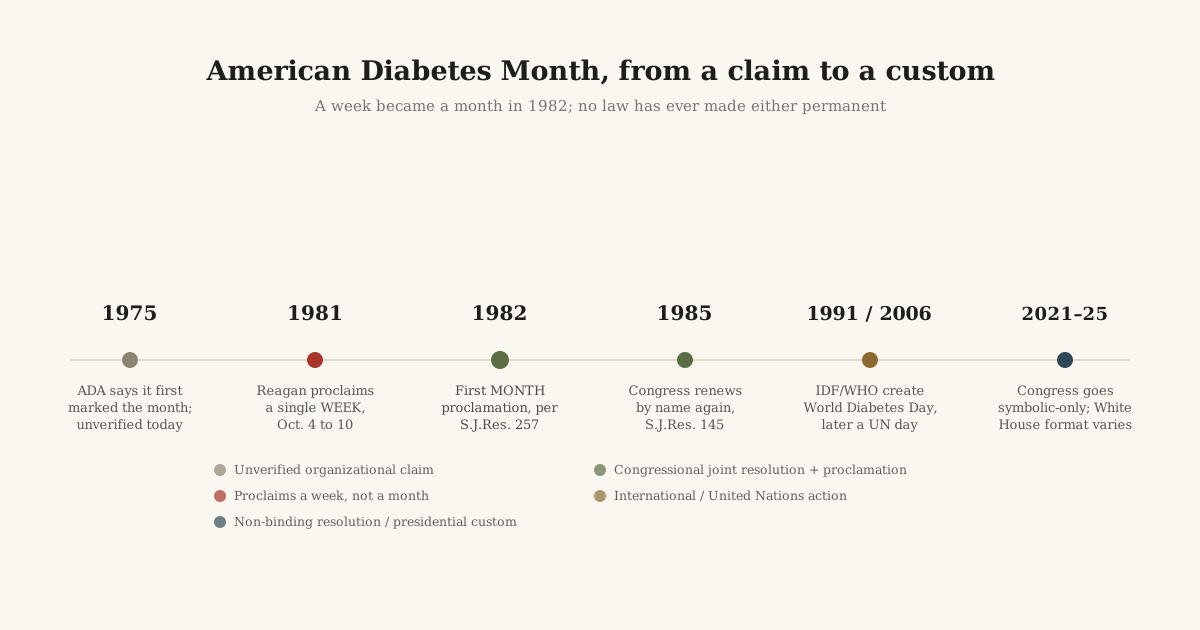
Timeline from 1975 to 2025 showing the American Diabetes Association's unverified 1975 claim, Reagan's 1981 week and 1982 month proclamations, the 1985 congressional renewal, the 1991/2006 creation of World Diabetes Day, and the 2021-2025 shift to non-binding resolutions and a varying White House format

Frequently asked questions

When is American Diabetes Month in 2026?

All of November 2026, running Sunday, November 1 through Monday, November 30. It covers the entire 30-day span rather than a single date, so there's no weekend shift to account for.

Who founded American Diabetes Month?

The ADA points to 1975 as its founding year for the observance, though no current document on the group's own site backs that date up. On the federal side, Reagan's earliest move came in 1981 and covered only a week, not a month. A full month under this name wasn't signed into effect until the following year, when Congress passed the joint resolution behind it.

Was National Diabetes Month first proclaimed in 1981?

No, despite what a couple of diabetes-focused sites currently claim. Reagan's first move on this topic came in 1981 (Proclamation 4861), and it covered just seven October days, calling that stretch a Week, not a Month. A document naming a full 30-day month didn't follow until November 2 of the next year.

Is American Diabetes Month the same as World Diabetes Day?

No. One is a single day, one is a whole month, and they were set up by entirely different bodies a decade apart. The November 14 day is a UN-recognized international observance that two global health bodies launched in 1991; the US month traces to Reagan-era proclamations that predate it.

What is the difference between American Diabetes Month and National Diabetes Month?

Only the name. Secondary sources date the ADA's switch to the “American” label to 1997, while Washington has stuck with the “National” version on every document this calendar reviewed going back to Reagan. Whichever label a given source reaches for, both describe the identical 30-day span in November.

Embed this countdown

Paste this into any blog post or web page to show a live "days until American Diabetes Month: A Week in 1981, a Month in 1982" counter, free to use, with the attribution link staying in place.

Reader's note

Was this day's page useful?

Written and edited by the DayAlmanac Editorial Team