Two different observances share this month
National Suicide Prevention Month runs across all of September in the United States. Nested inside it is a separate, more specific observance: World Suicide Prevention Day, every September 10, created in 2003 by the International Association for Suicide Prevention (IASP) with the World Health Organization (WHO) as co-sponsor. The two are often used interchangeably in casual writing, but they have different founders, different founding years, and, as the next two sections lay out, very different relationships to actual government action.
The single day has a clean founding: a named pair of organizations, a specific year, and an annual presidential proclamation that both the Obama and Biden administrations issued for September 10 in the years this page checked. The month is where the record gets murkier. Most of what gets repeated about it, that "Congress recognizes it" or "the President has designated it," does not hold up against the primary record.
From a May week to a September month, with no law in between
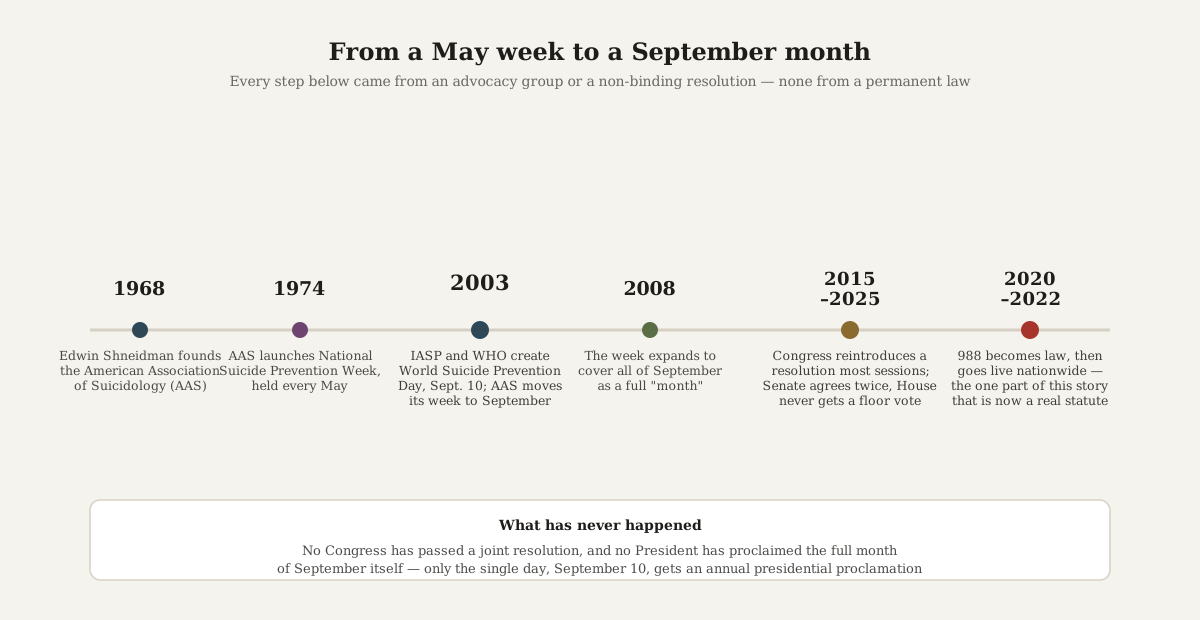
AAS's own site confirms the organization was founded in 1968, after Shneidman's work at NIMH's Center for Suicide Prevention highlighted the absence of any national coordinating structure for suicide research and prevention. What AAS's currently live pages do not spell out is the chronology of the awareness week that eventually became this month. That account comes from secondary retrospectives, not from a primary document this page could verify on suicidology.org today.
By that secondary account, AAS launched a National Suicide Prevention Week every May starting in 1974. It stayed in May for nearly three decades. In 2003, the same year IASP and WHO created World Suicide Prevention Day for September 10, AAS moved its week to September to align with the new day. In 2008, the week expanded to cover the entire month, the version most people mean today when they say "National Suicide Prevention Month."
None of these three changes, the 1974 launch, the 2003 move, or the 2008 expansion, came from Congress or the White House. Each was a decision made inside an advocacy nonprofit. That distinguishes this observance from something like Domestic Violence Awareness Month, which reached an actual one-time federal statute in 1989, or American Diabetes Month, which has a Reagan-era presidential proclamation on record from 1982. National Bullying Prevention Month sits at the far end of that same spectrum: founded by a single nonprofit in 2006, and never proclaimed by any President at all.
What Congress has actually voted on
Searching the primary congressional record turns up a recurring pattern rather than a single founding vote. A resolution recognizing suicide as a national problem, sponsored by then-Senator Harry Reid, passed the Senate in 1997 (S.Res. 84), but its text never mentions September or a monthly designation. It is a general statement of priority, not the origin of this specific observance.
The specific "designate September as National Suicide Prevention Month" language starts showing up as its own resolution later. In the House, versions have been introduced in at least four separate Congresses: H.Res. 850 (114th, introduced September 2016), H.Res. 1067 (115th, September 2018), H.Res. 1436 (118th, 2024), and H.Res. 697 (119th, 2025). Every one of them was referred to committee and died without a floor vote, according to GovTrack's tracking of each bill's status.
The Senate side has actually succeeded twice: S.Res. 636 in the 115th Congress and S.Res. 738 in the 116th Congress were both agreed to by unanimous consent, a real vote (even if a non-recorded one) rather than a dead-end committee referral. But a Senate resolution agreed to in one Congress does not carry into the next; each expires with that two-year session and has to be reintroduced from scratch. The 119th Congress's Senate version, S.Res. 385, introduced in 2025 for that year's September, was still sitting at "introduced" as of this page's research in August 2026, meaning even the chamber that has passed it before did not get it done that time.
No joint resolution, the kind of measure that would need both chambers and the President's signature to become binding, has ever been introduced for this specifically. No President has proclaimed the full month of September as National Suicide Prevention Month in the sources this page checked. The proclamations that do exist, described next, are for the single day only.
The one part of this story that is now a real law
Set the month aside and look at September 10 alone: Obama proclaimed World Suicide Prevention Day in at least 2015 and 2016, and Biden did the same in 2021 through 2024, each a named, dated presidential document in the Federal Register. That is a different category of federal recognition than anything the month has received, an annual proclamation, tied to a single day, that multiple administrations have kept up.
The one piece of this whole subject that became an ordinary federal statute is neither the day nor the month. It is the 988 phone number. The National Suicide Hotline Designation Act of 2020 (S. 2661) passed the Senate on May 13, 2020, passed the House on September 21, 2020, and was signed into law as Public Law 116-172 on October 17, 2020. It required the FCC to designate 988 as the nationwide three-digit number for the National Suicide Prevention Lifeline and the Veterans Crisis Line. Telecom carriers had to activate it by July 16, 2022, and it has operated as the 988 Suicide & Crisis Lifeline ever since.
That contrast is the clearest way to see what has and has not happened at the federal level: a concrete piece of infrastructure, a phone number everyone can dial, went through both chambers and got a President's signature. A calendar designation for a month has not, in any version this page found in the record.
If you or someone you know is in crisis, the 988 Suicide & Crisis Lifeline is reachable by call or text, 24 hours a day, anywhere in the United States.
What the most recent data shows
The CDC's National Center for Health Statistics reported that the age-adjusted suicide rate in the United States was 14.1 per 100,000 people in 2023, essentially unchanged from 14.2 in 2018, a five-year period of roughly flat, still-elevated rates rather than a clear rise or fall. Suicide was the 11th leading cause of death overall that year, accounting for more than 49,300 deaths.
The rate is not evenly distributed: the 2023 rate among men, 22.7 per 100,000, was close to four times the rate among women, 5.9 per 100,000. Both figures come from the same NCHS data brief, not from separate, less comparable sources.
Where this sits next to the rest of this calendar's awareness months
This site has now checked the federal paper trail behind several awareness months, and the results form a rough spectrum rather than a single pattern. Domestic Violence Awareness Month reached an actual congressional joint resolution behind a specific year, 1989's Public Law 101-112, and Congress went back and renewed that same one-year designation once more for 1991, but nothing has renewed it since. ADHD Awareness Month has a documented five-year run of Senate resolutions, 2004 through 2008, each agreed to without objection, before the practice simply stopped with no sixth attempt found. Epilepsy Awareness Month has the weakest record of the three: three separate resolutions across three different Congresses, and not one of them ever reached a vote in either chamber.
National Suicide Prevention Month lands closest to the ADHD pattern but less consistent even than that. The Senate has agreed to it twice, not five times running, the House has never passed it at all, and the most recent attempt, for 2025, stalled in both chambers. What the month has that none of the others do is a well-documented single day nested inside it, World Suicide Prevention Day, that keeps getting a real presidential proclamation even while the month around it does not.